




Beyond Macros: Why Your Nutrition App Should Track 25+ Micronutrients
Most nutrition apps track six numbers. TactiFit tracks 25+ micronutrients including vitamins, minerals, and electrolytes. Here is why the difference matters — and what you are missing if your tracker stops at calories, protein, carbs, and fat.
Most nutrition apps show you six numbers: calories, protein, carbohydrates, fat, fiber, and sodium. Hit your targets on those six and you are done. Except that is not actually how nutrition works — and there is a meaningful cost to pretending it does. TactiFit tracks more than 25 nutrients because the six-number model consistently misses the things that determine whether you actually feel good, recover well, and stay healthy over time.
The Six-Number Problem
The six-number model exists because it is simple to understand and easy to implement. Calories and macros are the primary levers for body composition goals — lose fat, build muscle, maintain weight. Those goals are real and tracking macros against them works. But the human body does not run on macros alone.
Vitamins, minerals, and electrolytes govern hundreds of physiological processes that have nothing directly to do with calorie balance. Your energy levels, immune function, sleep quality, muscle recovery, bone density, hormone regulation, and cognitive performance all depend on micronutrient availability — and none of those show up in a six-number log.
The result is a class of symptoms that confuse a lot of people who are otherwise "doing everything right." You are hitting your calories and macros. You are training consistently. But you are chronically tired, sleeping poorly, getting sick more than you should, or recovering slower than expected. Macro-only tracking gives you no data to investigate. You have hit every number in your app every day, and something is still clearly wrong.
What 25+ Micronutrients Actually Covers
TactiFit tracks the full picture of nutritional intake. Beyond calories and macros, the nutrient panel includes:
Electrolytes
Sodium, potassium, magnesium, calcium, and phosphorus. These are particularly important for anyone who exercises regularly. Sweat depletes electrolytes, and most trackers only show sodium — which is the one electrolyte most people already get too much of. Potassium and magnesium deficiencies are extremely common and rarely detected because they do not appear in standard macro-only logs.
Low magnesium is associated with poor sleep quality, muscle cramps, fatigue, and difficulty managing stress. Low potassium affects muscle function and cardiovascular health. Neither appears in a six-number dashboard.
Fat-Soluble Vitamins
Vitamins A, D, E, and K. Vitamin D deficiency affects a large portion of the population, especially in northern climates or people who spend most of their time indoors. Its effects include reduced bone density, suppressed immune function, low mood, and fatigue — all of which are commonly attributed to other causes because most people have no way of tracking their vitamin D intake.
Fat-soluble vitamins also have toxicity thresholds — they accumulate in body tissue and can reach harmful levels if consistently over-consumed. Tracking them gives you a ceiling as well as a floor to work within.
B-Vitamins
Thiamin (B1), Riboflavin (B2), Niacin (B3), Pantothenic acid (B5), B6, Biotin (B7), Folate (B9), and B12. B-vitamins are involved in energy metabolism, red blood cell production, and neurological function. B12 deficiency is particularly common in people who eat limited animal products, and its symptoms — fatigue, brain fog, mood changes — develop gradually over months to years.
Folate matters significantly during certain life stages. The full B-complex panel gives you a complete picture of where dietary intake is supporting your energy systems and where gaps exist.
Trace Minerals
Iron, zinc, copper, manganese, selenium, chromium, and molybdenum. Iron deficiency is one of the most common nutrient deficiencies worldwide, and it is not always detectable through symptoms alone until it has progressed significantly. Zinc plays a critical role in immune function and wound healing. Selenium is an antioxidant with thyroid implications. None of these appear in standard macro-only tracking.
Why Most Apps Stop at Six Numbers
Tracking 25+ nutrients is technically harder. It requires a more complete database with verified micronutrient data for each food entry — not just calorie and macro counts, which are the minimum required for food labels. It requires a more complex interface to display the data without overwhelming the user. And it requires the AI and reporting layer to synthesize micronutrient data into useful insights rather than just showing you a long list of numbers.
Most apps stop at six numbers because building the database and the interface for 25+ is significantly more work, and most product teams decided that users do not care enough to pay for it. TactiFit takes the opposite position: users do not know to ask for it because they have never had it. Once you can see your full nutritional picture, the six-number model starts to look like what it is — an incomplete proxy for actual nutrition.
How TactiFit Surfaces Micronutrient Insights
Tracking 25 numbers daily without any synthesis would be overwhelming and useless. The goal is not to give you more data to stress about — it is to make micronutrient patterns visible and actionable.
Daily Nutrient Panel
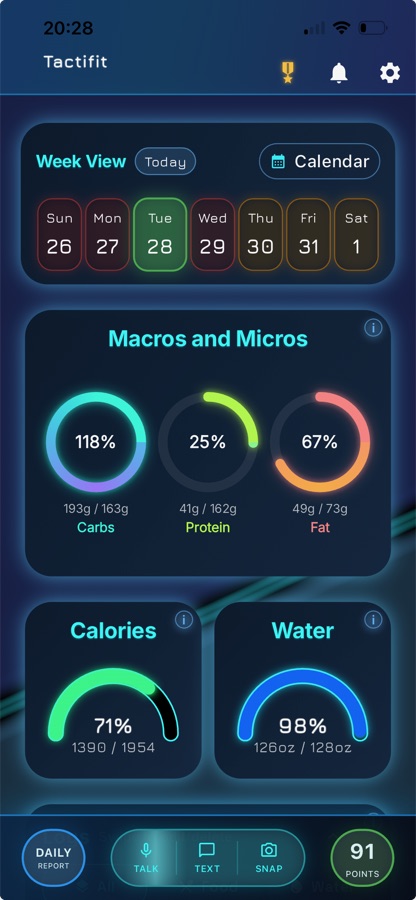
Your daily summary shows progress against targets for each tracked nutrient with visual indicators for over, under, and on-target. Color coding draws attention to consistent shortfalls without requiring you to manually audit a spreadsheet of numbers.
Trend Detection
Single-day nutrient data is noisy. What matters is whether you are consistently low on something over time. TactiFit's trend analysis identifies nutrients where you are systematically under-consuming week over week — the ones that are actually affecting your health versus one-off days where you happened to skip a food you normally eat.
Coach Aire Integration
Coach Aire, TactiFit's agentic AI coach, incorporates micronutrient data into her recommendations. If you have been consistently low on magnesium for the past week, her daily recommendation might be to add a handful of almonds or a serving of leafy greens to your next meal — a specific, data-driven suggestion rather than generic nutrition advice.
This is what separates a micronutrient-aware AI from a standard macro coach: she is working from your actual nutritional gaps, not a general template of what healthy eating looks like.
Practical Impact: What Changes When You Can See This Data
The most common shift users report is understanding why they feel the way they feel. Not "I think I might be low on something" — actual data showing a consistent pattern of low potassium or insufficient vitamin D that connects to specific symptoms they have been experiencing.
The second shift is in food selection. When you can see that a particular meal leaves you significantly low on a specific micronutrient, you start making small adjustments — an extra handful of spinach here, a different protein source there — that accumulate into meaningfully better nutrition without requiring dramatic dietary changes.
The third shift is in supplement decisions. A lot of people take supplements based on vague concerns or marketing rather than identified gaps. Micronutrient tracking gives you actual data to work from: if your folate is consistently on target from food alone, you do not need to supplement it. If your vitamin D is chronically low, you have evidence for the decision to address it.
Start Tracking the Complete Picture
TactiFit is available on iOS and Android with a 14-day free trial. Both the Rapid plan ($4.99/mo Founders rate) and Premium plan ($8.99/mo Founders rate) include the full 25+ micronutrient tracking panel, daily nutrient reports, and trend analysis. The Founders Promotion runs through December 31, 2026.
If you have been tracking macros and wondering why you still feel off, the answer might be in the 19 numbers your current app is not showing you.