




Log Your Meal in 5 Seconds or Less
The number one reason people quit calorie tracking is time. Here is how TactiFit's snap, voice, text, and barcode logging gets a full meal into your log in under five seconds — and why that speed changes everything.
The number one reason people quit tracking their nutrition is not willpower. It is not motivation. It is time. Specifically, the two to four minutes it takes to find a food, match the right database entry, and manually enter portions in a traditional tracker. TactiFit eliminates that friction completely — most meals log in under five seconds.
Why Traditional Logging Kills Every Streak
Think about the last time you ate something and told yourself you would log it later. You did not. And once you missed one meal, you likely abandoned the whole day. This is the friction death spiral that ends nutrition tracking for most people — not once, but repeatedly across every app they try.
The problem is not discipline. It is interface design. When logging costs three to four minutes per meal — searching through a crowded database, scrolling past wrong results, manually adjusting serving sizes — the mental overhead accumulates fast. After a few weeks the app becomes something you open out of guilt rather than habit. Then it stops getting opened at all.
The only real fix is radical speed. If logging a meal takes about the same time as glancing at your plate, the habit becomes sustainable. If it takes longer than that, it will eventually get skipped.
Four Ways to Log. One Ceiling: Five Seconds.
TactiFit does not force you into a single logging pattern. It works however you naturally communicate — because the best logging interface is the one that fits the moment you are actually in.
Photo Logging
Snap your plate. That is it. TactiFit's AI identifies every visible item — ingredients, estimated portions, preparation style, toppings, sauces — and automatically fills in calories, protein, carbs, fat, and micronutrients. From camera tap to confirmed log entry typically takes three to five seconds. You can review and adjust before confirming, but in most cases the AI is accurate enough that you are just hitting confirm. No typing. No searching. No back and forth.
Photo logging is especially powerful for restaurant meals and anything you did not prepare yourself, where you have no idea what the exact recipe looks like. The AI estimates from what it sees — and flags anything uncertain so you can make a quick judgment call.
Voice Logging
Driving home from the gym? On a call? Hands full with groceries? Say it out loud: "Two scrambled eggs, one slice of sourdough toast with butter, and a cup of black coffee." TactiFit transcribes it, parses the individual components, cross-references the 2-million food database, and returns a complete nutrition breakdown for your confirmation. Hands-free. Eyes-free. Done before you finish the sentence.
Voice logging handles complex mixed meals that would take three to five minutes to build entry-by-entry in a traditional interface. A full breakfast description becomes a confirmed log in the time it takes to say it.
Text Logging
Already reaching for the keyboard? Type shorthand: "6oz salmon, 1 cup brown rice, side salad." TactiFit's text parser understands standard cooking shorthand, restaurant item names, brand names, and natural descriptions. You do not need exact gram weights — the system makes calibrated estimates based on standard servings and flags anything it is uncertain about.
"A bowl of oatmeal" and "one cup steel-cut oats with water" route to the same accurate nutritional result. The parser handles ambiguity the way a knowledgeable human would — by defaulting to the most common interpretation and letting you adjust if needed.
Barcode Scanner
For packaged foods, the barcode scanner pulls verified product data and imports the label exactly — no searching, no estimation, no mismatch between what the package says and what your log shows. Point, scan, confirm. Two seconds.
The barcode database is cross-referenced against verified sources, which matters because user-submitted barcode entries in competing databases are notoriously unreliable. You want the nutrition facts from the actual label, not an approximation someone entered years ago.
The 2-Million Food Database Behind the Speed
Fast logging only works if the retrieval is accurate. A quick interface that returns wrong nutritional data is worse than a slow one — you end up logging with false confidence.
TactiFit's database includes over 2 million food entries cross-referenced against verified nutritional sources. When the AI identifies a food from a photo or parses a voice description, it is matching against validated entries — not the user-submitted crowd-sourced data that makes competing trackers unreliable.
This matters more than most people realize. Search "grilled chicken breast" in a popular open-database tracker and you will find entries ranging from 100 to 450 calories for what looks like the same serving. Those entries were submitted by different users with different interpretations of "serving size." TactiFit's cross-reference layer filters these outliers and returns values grounded in actual nutrition data.
Real-World Scenarios: Where the Speed Advantage Actually Matters
At a Restaurant
Your food arrives. You have about 30 seconds before photographing your plate becomes socially awkward. One shot while positioning your plate normally is enough. By the time you put your phone down, the log entry is ready for your confirmation. No manual entry needed.
Post-Workout
Your hands are tired, you are hungry, and you just want to eat. Voice log your protein shake and meal without touching the screen. "Chocolate protein shake, one scoop, banana, cup of Greek yogurt" — confirmed before you finish pouring.
Home Cooking
Text log as you cook: "half cup olive oil, three chicken thighs, two cloves garlic, one cup quinoa." Specify how many servings the recipe makes, and the per-serving breakdown calculates automatically. The whole recipe is logged before the water boils.
Meal Prep
Barcode scan each packaged ingredient as you add it to the batch. The totals divide by portion automatically. An entire week of prep gets logged in the time it takes to open each container.
What Consistent Logging Actually Gets You
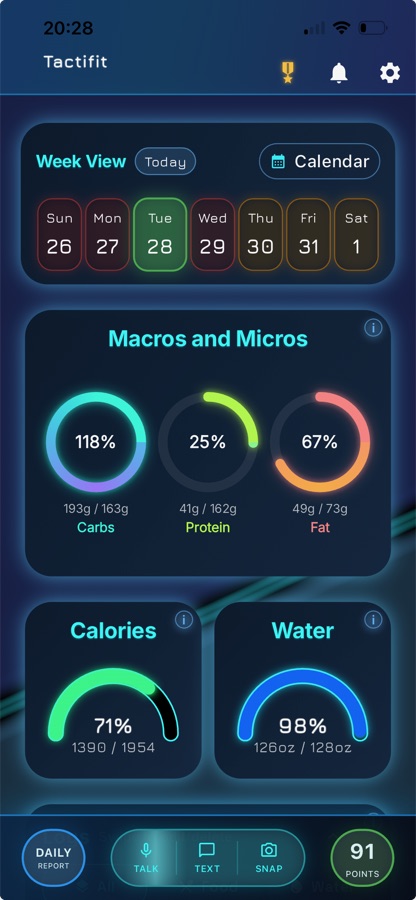
The goal is not to have a log — it is to have enough data to make better decisions. When logging is fast enough to actually do consistently, TactiFit generates insights you cannot get from a patchy log: your real average calorie intake versus target, where you consistently fall short on protein, which meal times are pushing your sodium over. Patterns that only appear in complete data.
Coach Aire, TactiFit's agentic AI, uses your accumulated log to give you one specific, actionable recommendation daily. Not generic advice — a precise observation based on your actual patterns. "You have come in under your protein target four of the last five days. Your next meal is a good opportunity to close that gap." That kind of specific guidance is only possible when the data is complete. And the data is only complete when logging is fast enough to not skip.
The five-second ceiling exists because complete data is what makes the intelligence useful. Everything else in the app — the meal planning, the scoring, the adaptive macro adjustments, the daily reports — runs on what you log. Make logging effortless and everything downstream gets better.
Try It Free for 14 Days
TactiFit is available on iOS and Android. The Founders Promotion includes a 14-day free trial with full access to every logging mode, the complete 2-million food database, Coach Aire, and all features — starting at $4.99 per month after trial. No commitments. Cancel anytime from your App Store or Google Play subscription settings.
If you log three meals a day, that is roughly 45 seconds of total daily tracking time. For most users, this is the first nutrition app that does not eventually get deleted for being too tedious to maintain.